

AI in PR budgets is a topic when it comes to the sales pitch, but most of what I have read sounds a bit like a marketing brochure. That’s why I’m looking at this from a balanced point of view. I have never handled a budget, so I can’t give advice on saving money from an agency’s side. Instead, I will look at where AI can help a team, where it doesn’t work well, and how to create a division of work.
Why AI in PR Budgets Matters
Most teams I know are being asked to prove their value without money. They usually spend that money on agency retainers, media event costs, content creation, influencer work, and monitoring software.
The place for AI in PA Budgets this list isn’t necessarily things, but the time saved on tasks that take up a lot of a job on ai in budget
However, time is money if the result is good enough, and automated results can need more reviews that turn into more costs.
Where AI Can Help Save Money AI in PR Budgets
I think that most of the time AI is helpful AI in when used with a proofreader on tasks that are repeated and not very risky. It can handle:
– drafts of press releases, media pitches, FAQs, and briefing documents. If the writer stares at a page for more than a few minutes, automation will help
– Monitoring and analysis of coverage sorted by relevance and sentiment, with a summary of what was found
– General research and collecting facts, numbers, and opinions that are relevant to a topic, including news mentions
– Changing approved content and talking points into blog posts, social media updates and other media
– Administrative tasks, including summaries of meetings and emails and regular reports on ongoing projects
With these time-saving tools, a team can focus on messages and media that need human input.
Where AI in PR Budgets Can Increase Costs
1. Journalist outreach and keeping relationships AI in Budets
A simple AI script can write a media pitch in seconds and even make it personal for a specific outlet. However, there is no guarantee that the message will be better for the journalist than before, and an automated email might not pass the test – of not sending to the wrong people.
2. Checking facts. Approving messages
AI tools might create text with numbers and quotes that seem real, but every single claim needs to be checked by a human fact-checker. Even if the data is correct, there is always a chance that the logic connecting the facts to support an argument is wrong.
3. Handling a crisis
In a PR budget crisis, someone has to look at what’s happening and decide the best response. AI can help organize the information and suggest a position. The final decision has to be made by a human communicator.
4. Communicating in sensitive situations
Apology letters, announcements about employees, and customer complaints all need a level of care and understanding that AI in PR Budgets tools can’t handle. They can be programmed to sound more formal or kind. How they are received depends a lot on what is happening and what the audience thinks.
5. Thinking strategically. Evaluating
An AI in PR Budgets check can collect data about how much media coverage there is, but it needs a person to see if the numbers support the goal. More numbers are not always better. The right audience has to be found.
How to Divide Tasks Between AI and Human PR Professionals
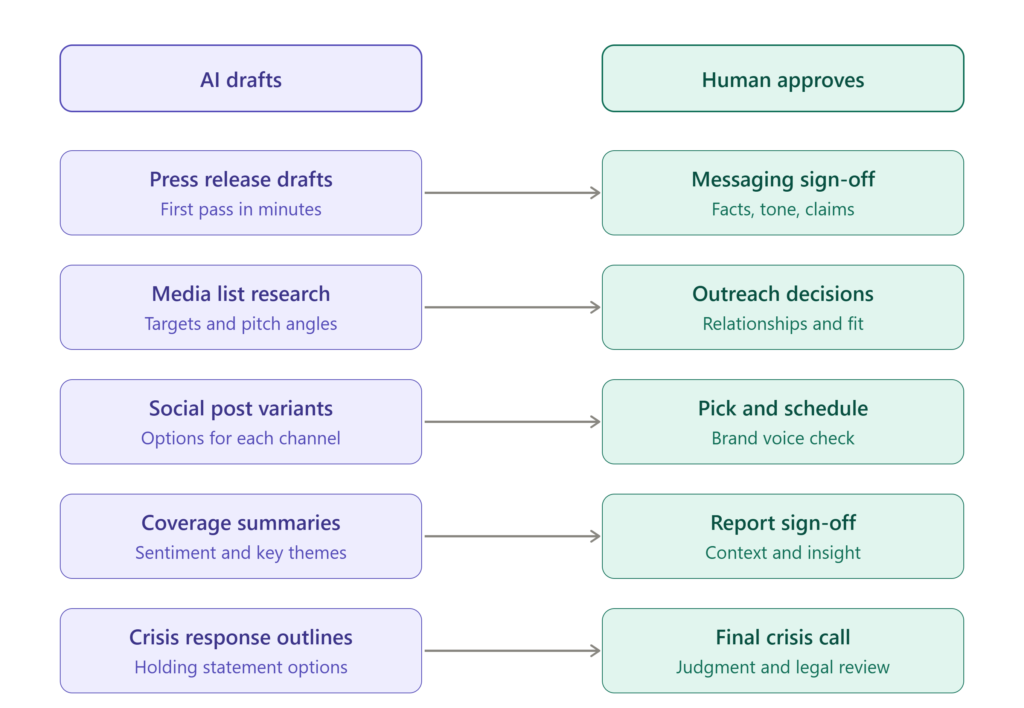
Task Good AI in PA Bu Role Human Responsibility
– Writing press releases: First draft, including the way it is set up; checking facts, numbers, and language
– Writing media pitches: Ideas based on what a journalist likes and what topics they cover; checking facts; keeping relationships
– Monitoring and reports: Sorting data into the right groups; checking the results; interpreting the numbers
– Handling a crisis: Sorting messages and organizing information; making the final decision on the message and how it is written
– Planning the budget: Creating different scenarios and comparing numbers; approving the money that is suggested
– Evaluating a campaign: Summarizing the report, noting trends, checking the conclusions and analysis
A Real Example of Wrong AI Assumptions: The Fake Claim
I can give one example of an automated message that needs human help. Imagine an AI -generated media pitch that includes one number, one unrelated piece of research, and one completely made-up fact from the company’s history. All the statements make sense. It’s hard to tell which are not true. AI in Budgets
This situation might be based on something or made up, but the process to fix it is the same either way.
The corrected message would have to get rid of all the claims, which could mean taking out whole sentences. Then it would need to be changed to fit a journalism angle if there is one, or a specific reason to reach out. Finally, the facts would need to be checked for accuracy and relevance. Any questionable contact details would be removed. The time-consuming part is always the checking because of the risk of hurting the reputation and the need for correct information.
A Real Example of AI in PR: The Risk of False Claims
As a thought for this article, I want to suggest three rules for using AI in a PR budget. The first is to automate tasks and use AI for low-priority work. Summaries and similar documents can have a check before being approved, while more important items need more in-depth checking.
The second rule is to make sure that any AI in Budgets writing is checked by a person. At the least, an automated message should say that it was written by an AI tool and then checked by a person. A better way is to check the facts before it is published.
Finally, when using information, the team has to be careful with security. AI tools should only be used on approved platforms. Any data rules have to be followed.
Three Rules for Using AI in PR Budgets
The thing I want to talk about in this article is whether it is worth spending time and money on AI tools. I can’t give an answer without testing, and testing means spending time, which I’m not ready to do right now. This problem is common with rule-based AI in PR Budgets fdraft to make it more personal or fit a journalist. Finally, I would compare the time with the other option – writing the pitch by hand.
[INSERT YOUR RESULTS or delete this section if you haven’t done the test.]
Frequently Asked Questions About AI in PR Budgets
Can AI make PR costs lower?
It has the chance to save money on writing, reporting, and administrative work. The time saved can be used on projects, but checking AI in PR Budets work often needs more work.
Is it okay to use AI tools with client data?
Only if the company approves. Confidential data has to be protected, including details of clients, workers, or other people.
Will AI PR workers?
In my view, it won’t. The job of a communicator should always be done by people. This is my opinion, not a fact.
What should a team think about automating?
It depends on the team’s needs. I think starting with less important things, like summaries and reports, is a good idea.
To wrap up, AI can be a tool in budget planning for a PR team. It makes the routine work easier, giving time for important tasks. At the same time, using AI carelessly can hurt the agency’s reputation. This article gives tips on how to use AI in budgets for better results. To start using these ideas, try these steps:
– Choose one task to automate this month.
– Add a check for any AI in PR Budgets work.
– Do a test to see how the tool works.
How to Measure the Cost-Effectiveness of AI in PR
Internal links (add 3 per your SEO skill): “How to Report on AI in PR Budgets Campaign’s Effectiveness” or another post on evaluation, “Writing a Media Pitch: Examples and Advice,” and “Agency Retainers in PR Budgeting” or “How Much Does PR Cost?” Anchors:AI in PR Budgets performance reporting, media pitch examples, PR budgeting tips.
External references (verify URLs before publishing): PRSA (prsa.org) for the code of ethics; CIPR (cipr.co.uk) for the AI guidelines; and a relevant industry paper such as Muck Rack’s State of AI in PR Budgets. Anchors: practices for AI in PR Budgets media pitch examples,AI in PR budgets tips.
Conclusion: Use AI in PR Budgets as a Tool, Not a Replacement
AI in PR budgets works best when it takes over the repetitive, low-risk jobs: first drafts, coverage summaries, routine reports and admin. That frees a team’s time for the work that needs judgment. Journalist relationships, fact-checking, crisis decisions and sensitive messages should stay with people, because careless automation can cost more in corrections and lost trust than it saves.
Whether AI really lowers costs for your team depends on one thing: how long checking and editing the output takes compared with doing the work yourself. I haven’t run that timed test yet, so treat the points in this article as a framework to try, not proven results.
To get started this month:
- Choose one low-risk task to automate, such as meeting summaries or a monthly report.
- Add a human review step before anything is sent or published.
- Time the task with and without AI, then compare.
If you’re a small business or startup in Kerala and want help applying AI to your marketing and PR budget without wasting money, I’m a freelance digital marketer in Pathanamthitta and happy to talk it through. Get in touch, or sign up for the newsletter for the free checklist.