
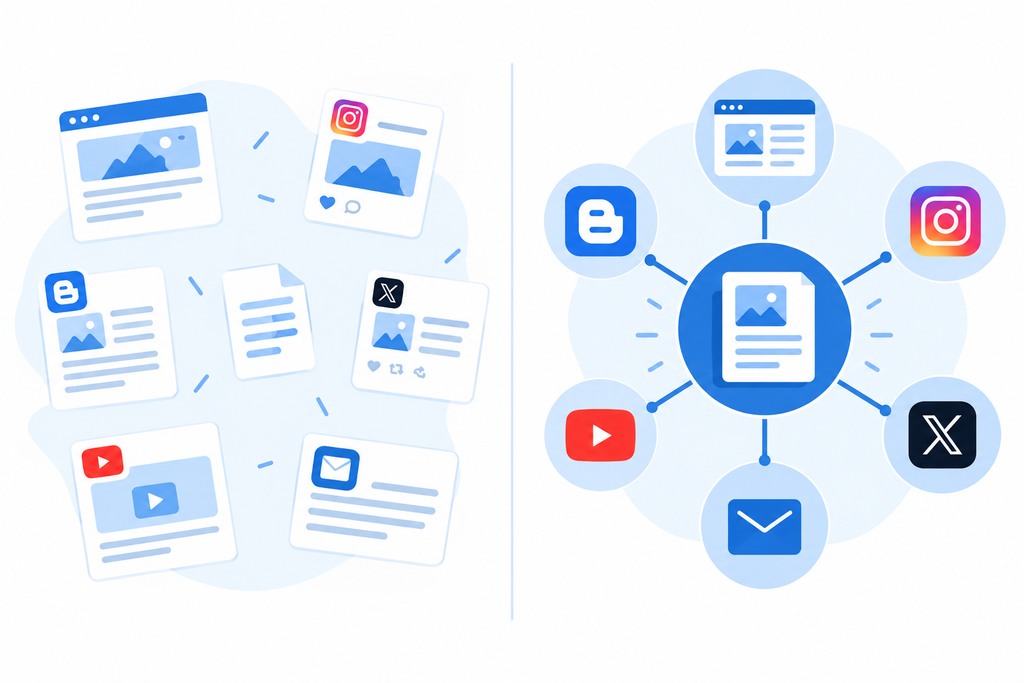
The rise of AI technologies has made content creation easier than ever. This openness of production brings an unexpected result: the huge amount of content makes quality less valuable. The value of a brand’s content is no longer about how much there is; it is about how it’s organized, how it makes sense, and how it shows knowledge. An AI content ecosystem helps with these issues by offering regularity, SEO-focused ideas, saving time through automation, and using information in different ways.
: AI Content Ecosystem: Benefits, Strategy, and Best Practices
• Regularity. Your website, blog, and social media will be unified, as an AI content ecosystem aligns everything with a shared plan.
• SEO. Keywords and what people are looking for will be part of every step of creating content, from blogs to media.
• Time. An AI content ecosystem handles all the repetitive, slow parts of writing.
• Wasted space. This is what content ecosystem marketing is about: each piece of content has its job, but it supports the whole. An AI content plan. Shapes the purpose of every single item. How did I use this idea on my website? My digital marketing portfolio website is an example. I used AI to create a plan based on SEO and keywords. The technology helped me change the words on my pages that offer kinds of digital marketing services like SEO, social media marketing, and content marketing.
AI gave me some starting ideas and rough drafts. I made the language better to fit what my audience wanted. Importantly, this process changed how I see the role and function of each page. The regularity was clear. The purpose of each page was fully used.
Since this was a rewrite, I don’t have numbers to show how much this made a difference. It is safe to say that this way was better than anything I tried before. It gave direction and a plan for improving my website’s search engine optimization and getting more clients
I use the following steps for content:
1. Figure out who the content is for and what it is meant to do.
2. Do keyword research. Talk with an AI assistant.
3. Make an outline, putting the important headings first based on what people are searching for.
4. Use AI to create a draft, remembering that this is just the start.
5. Make sure it is good for search engines, focusing on keywords, subheadings, and the meta description.
6. Use the content in different places, changing it for each group.
7.Read it again. Publish the final version.
8. Check how well the content is doing.
AI Content Ecosystem
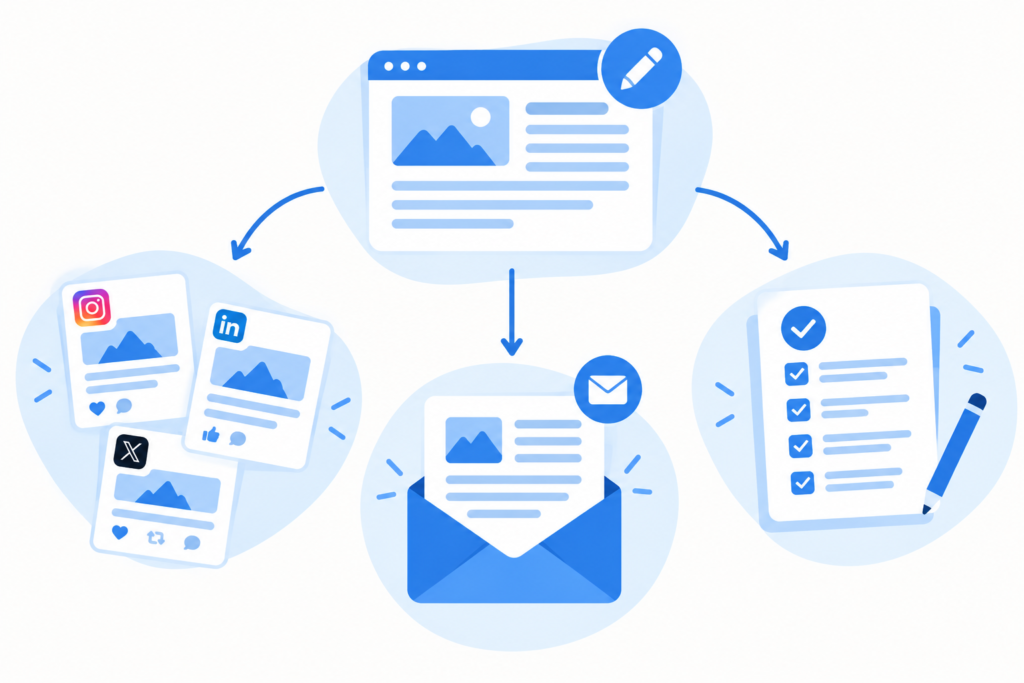
An example will make it clearer. Let’s say you wrote a blog post called “SEO Tips for Businesses.” In an AI content ecosystem, this post would. Appear in the following ways:
• Three different social media posts talking about the main points of the blog and made to work with search engines.
• An email newsletter with a summary of the blog and a link to it.
• A printable guide about SEO based on the tips in the blog.
• Changes to pages on the website to match the blog’s ideas.
Common Errors When Using an AI Content Ecosystem
I have made all of these mistakes more than once, and I am still learning how to avoid them. First, it’s important to remember that AI content is rarely ready to publish. Always check facts. Make sure the information is correct, especially if it came from somewhere else. Second, even if it is hard, never forget the value of your style and experience. These are missing in AI content. Third, don’t forget to make content good for search engines and match the brand’s style. Finally, remember that quality is more important than how many articles you have. Making thirty low-quality articles won’t help as much as five good ones. This way has problems, and how well an AI content ecosystem works depends on the industry, the people who read it, and the competition. So this guide and my way should be used as a plan.
My suggestions are as follows:
1. Pick a topic that your audience likes and research words people use.
2. Use AI to create one blog post.
3. Make the draft better by adding your ideas and writing.
4. Use the content for social media posts, an email, and a checklist.
5. Watch how it does in Google Analytics and Search Console.
6. Once you get the basics, add parts.
Asked Questions
What is an AI Content Ecosystem?
An AI content ecosystem is a way of using intelligence to help make and share content marketing. It covers all the parts of writing, from planning to publishing, and making it better, but always to help the brand’s style and plan.
An AI content strategy is the plan, while an AI content ecosystem is putting that plan into action in a company. This guide talks about both an AI content strategy and an AI content ecosystem because they are connected.
AI Content Ecosystem Hurt My SEO?
Not if done right. It should help your SEO. Search engines like content that isn’t repeated or taken from others. These rules also apply to AI content.
Do I Need Special Tools to Make an AI Content Ecosystem?AI made content easy to produce, which is exactly why structure now matters more than output. An AI content ecosystem gives your content a plan, a voice, and a feedback loop, so each piece supports the rest.
Here are the takeaways:
Measure results aWhere an AI Content Ecosystem Falls Short
I’d be misleading you if I said this approach works everywhere. An AI content ecosystem has real limits.
It works poorly when a project needs deep personal experience, original research, or sensitive communication. It also struggles when you need a strong emotional connection with the audience. AI can repeat common ideas, sound generic, or state things that are simply wrong.
It can also backfire if the goal becomes volume. Thirty mediocre posts will not beat five genuinely useful ones. Results will also vary by industry, audience, and competition, so treat any workflow, including mine, as a starting point you adjustnd adjust.
Conclusion
AI made content easy to produce, which is exactly why structure now matters more than output. An AI content ecosystem gives your content a plan, a voice, and a feedback loop, so each piece supports the rest.
Here are the takeaways:
- Connect your content instead of creating each piece alone.
- Use AI for speed and ideas, and humans for judgment and experience.
- Start with one core piece and repurpose it.
- Measure results and adjust
AI for speed and ideas, and humans for judgment and experience.
freelance marketer in pattanamthitha
What Is an AI Content Ecosystem?
An AI content ecosystem is a connected system where AI tools help you plan, create, optimize, and distribute content across your website, blog, social media, and email. Instead of treating each post as a separate task, you build everything around one audience, one message, and one brand voice.
The key word is connected. Asking a chat assistant for a single blog post is not an ecosystem. It becomes one when that post feeds your social content, your newsletter, and your website updates.
Why an AI Content Ecosystem Is Essential for Modern Marketing
Most marketers use AI the same way. They open a chat, ask for a blog post, paste it into their site, and move on. The next day they repeat the process for social media, then again for email. Nothing connects.
That is exactly the problem an AI content ecosystem solves. It links planning, writing, SEO, and distribution into one system, so every piece of content supports the others. In this post, I’ll explain why it matters, how I use one for my own digital marketing portfolio, and where the approach falls short.
| Planning | Random topic ideas | Topics tied to audience needs and keywords |
| Brand voice | Changes with every prompt | Stays consistent across channels |
| SEO | Added at the end, if at all | Built in from the first outline |
| Distribution | One piece, one channel | One piece, many formats |
| Measurement | Rarely tracked | Tracked and fed back into planning |
How to Start Your First AI Content Ecosystem This Month
My best advice is to start small. Don’t try to adopt every AI tool at once.
- Pick one topic your audience cares about.
- Use AI to research keywords and draft one strong blog post.
- Edit it heavily and add your own experience.
- Repurpose it into social posts, one email, and a checklist.
- Track what happens in Google Analytics and Search Console.
Frequently Asked Questions
What is an AI content ecosystem?
It is a connected system where AI helps you plan, create, optimize, and distribute content across channels while keeping one consistent brand voice and strategy.
Is an AI content ecosystem the same as an AI content strategy?
Not exactly. An AI content strategy is the plan: goals, audience, topics, and rules. The ecosystem is the working system that carries out that plan across your channels.
Will AI-generated content hurt my SEO?
Not by itself. Accurate, original, and helpful content can perform well, while thin or unchecked AI content can hurt. Human review makes the difference.
Do I need expensive tools to build one?
No. Start with an AI assistant, a keyword research tool, and free analytics tools such as Google Analytics and Google Search Console.
My Step-by-Step Workflow
This is the process I follow for most pieces:
- Define the audience and purpose. Who is this for, and what should they do next?
- Brainstorm and research. I use AI to generate ideas and find keywords people actually search for.
- Build an outline. Headings come first, so the structure serves search intent.
- Draft with AI. The first draft is a starting point, never the final version.
- Edit and verify. I rewrite for my brand voice, fact-check, and add my own experience.
- Optimize for SEO. I improve headings, keywords, the meta description, and readability.
- Adapt for each platform. The same idea gets reshaped for my website, blog, or social channels.
- Check and publish. I review grammar, accuracy, formatting, and mobile readability.
- Measure and improve. Google Analytics and Google Search Console show what works.
The last step matters most. Without it, you have a publishing routine, not an AI content ecosystem.
A Simple Repurposing Example
Say you write a blog post called “SEO for Small Businesses.” In an ecosystem, that single post becomes:
- Three social media posts, each covering one key tip
- An email newsletter that summarizes the post and links back to it
- A short SEO checklist readers can save or download
- Updates to a related service page on your website
One idea, four formats, and a consistent message throughout.
Common Mistakes to Avoid
I see the same mistakes again and again:
- Publishing raw AI output. Without fact-checking, you risk inaccurate or generic content.
- Skipping personal experience. Readers and search engines both value first-hand insight that AI cannot invent.
- Ignoring SEO and brand voice. Content that doesn’t sound like you, or doesn’t match search intent, rarely connects.
- Chasing quantity. Publishing more AI-generated pages does not help if none of them are useful.
My fix is simple. I let AI handle speed and ideas, and I use human judgment for quality, accuracy, and authenticity. Google’s guidance points the same way: it treats AI-generated content as acceptable when it is helpful and made for people, not built to manipulate rankings. You can read it in Google Search Central’s guidance on generative AI content.
Where an AI Content Ecosystem Falls Short
I’d be misleading you if I said this approach works everywhere. An AI content ecosystem has real limits.
It works poorly when a project needs deep personal experience, original research, or sensitive communication. It also struggles when you need a strong emotional connection with the audience. AI can repeat common ideas, sound generic, or state things that are simply wrong.
It can also backfire if the goal becomes volume. Thirty mediocre posts will not beat five genuinely useful ones. Results will also vary by industry, audience, and competition, so treat any workflow, including mine, as a starting point you adjust.
How to Start Your First AI Content Ecosystem This Month
My best advice is to start small. Don’t try to adopt every AI tool at once.
- Pick one topic your audience cares about.
- Use AI to research keywords and draft one strong blog post.
- Edit it heavily and add your own experience.
- Repurpose it into social posts, one email, and a checklist.
- Track what happens in Google Analytics and Search Console.